Stuner Font Review: A Playful Psychedelic Typeface for Bold Branding
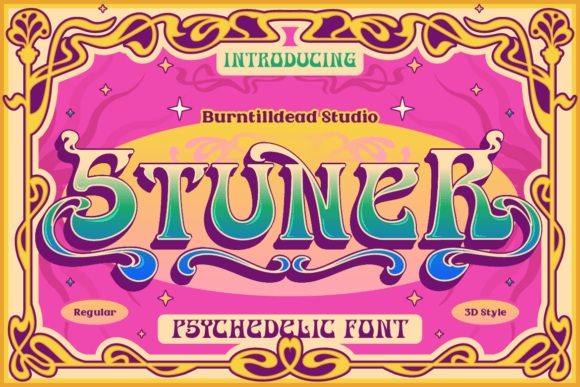
I was deep into a branding project for a local artisan coffee shop when I opened my brand board and felt the need to shake things up. The client wanted something that screamed creativity, nostalgia, and modern flair — all at once. That’s when I stumbled upon Stuner, a psychedelic font with 60s-70s retro energy and a contemporary edge. As a display font in two styles — Regular and 3D — it immediately caught my eye with its asymmetrical shapes and handmade feel.
Stuner on a Logo Concept for a Vintage-Inspired Café
I started by testing Stuner on a logo draft for the café. I paired it with a hand-drawn illustration of a steaming mug and some muted pastel colors. The result? Instant personality. Stuner’s irregular curves and playful distortions gave the logo a sense of whimsy and authenticity that other fonts just couldn’t match. It wasn’t over-the-top like some vintage typefaces can be, but it still carried that unmistakable retro charm.
The 3D version added depth without losing character. I used it as an accent in a layered logo concept where the main name sat in a clean sans serif, and “Roastery” was rendered in Stuner 3D. It worked beautifully, creating contrast while tying the design together with a tactile, almost sculptural presence. For this kind of logo system, Stuner proved itself a versatile and expressive choice.
Using Stuner in Brand Identity and Packaging Mockups
Next, I moved onto the brand identity board. I placed Stuner beside mood boards featuring retro photography and tie-dye textures. The font didn’t clash — it complemented. Its vintage vibe made it perfect for labeling special edition blends or promotional tags. I also tested it on a packaging mockup for their signature bag. At first glance, it looked like it belonged on a record sleeve from the late ‘60s, which was exactly the feeling the client was after.
However, I had to be careful with how much text I included. Since Stuner is a decorative display font, it works best in short phrases or headers. Using it for body copy would have been a readability nightmare. But for product labels, signage, and hero statements, it was a hit. I found myself using it more on label accents than on full descriptions — a smart way to balance style and function.
Stuner in Social Media Graphics and Web Design
On social media layouts, Stuner really shone. For Instagram posts promoting seasonal drinks, I used the Regular style as the headline and paired it with a minimalist sans serif for supporting text. The contrast was striking — enough to catch attention without overwhelming the user. In one layout, I even used the 3D variant behind a translucent background image, giving the post a subtle yet bold visual lift.
In web design, I experimented with placing Stuner in a hero section for the homepage. With a soft drop shadow and warm color overlay, it became the focal point without being distracting. The key here was ensuring sufficient negative space around it. Because of its intricate details and uneven spacing, Stuner needs room to breathe. I’d say it’s ideal for creative studios, lifestyle brands, or any website aiming for a retro-modern aesthetic.
Font Pairing Tips When Working with Stuner
One thing I learned quickly is that Stuner needs a strong supporting cast. On its own, it’s dramatic and colorful, but in a font pairing scenario, it requires a contrasting typeface to ground the design. I found that pairing it with a simple sans serif font like Montserrat or a serif font like Cinzel created a nice balance between the ornate and the structured.
It also pairs surprisingly well with handwritten fonts and script fonts when used sparingly. Think of it as a vintage graffiti tag next to a calligraphic flourish. Just remember to keep hierarchy clear — let Stuner lead where you want attention, and use the secondary font for clarity and legibility.
When Stuner Might Not Be the Right Choice
While Stuner is great for many branding elements, there are limits. I wouldn’t recommend using it for long paragraphs of text — even in digital formats. Its quirky structure and lack of uniformity make it unsuitable for body copy. Similarly, it’s not the best option for formal corporate identities or anything requiring strict professionalism.
That said, if you’re designing for a boutique, craft beer label, music festival poster, or a retro-inspired clothing line, Stuner could be your secret weapon. It’s got that artistic, handmade look that appeals to niche audiences looking for authenticity and visual interest.
Testing Stuner Before Final Client Deliverables
Before locking in Stuner for the client, I always test it across multiple platforms. I print it out on business cards to see how it holds up physically. I scale it down to check legibility in small sizes, and I render it in both high-contrast and low-light environments for web use. These tests helped me understand how it behaves under different conditions and confirmed that it’s best reserved for large-scale, short-form typography.
Another step I took was reviewing the included styles. While only two options (Regular and 3D) are available, they offer enough variation to build a dynamic typographic system. No extensive alternates or ligatures, but that’s expected for a decorative display font like Stuner. Still, I appreciated the thoughtfulness in the 3D treatment — it’s subtle enough to add texture without becoming garish.
Commercial Use and Licensing Considerations
One practical note before wrapping up: always review the font licensing agreement for Stuner before using it in commercial work. This includes everything from brand identity and packaging to templates and merchandise. If you're planning to use it on a website or in a print-on-demand product line, confirm that the license covers those uses. You don’t want to fall in love with a font only to find out later it doesn’t fit your legal requirements.
As for file formats, Stuner comes ready for most design tools, including Adobe Illustrator and Photoshop, making it easy to integrate into your workflow. If you're building a site, check if it supports webfont embedding — this will save you time later.
Final Takeaways from My Real-World Test with Stuner
After using Stuner across several real projects — from logos to social media assets — I’m convinced it’s a standout display font with a unique voice. It brings a sense of fun and originality that many modern fonts miss. And because it’s part of the broader category of Fonts, it fits naturally into a designer’s toolkit for stand-out creative projects.
If you’re working on a brand that wants to evoke nostalgia while staying fresh and current, give Stuner a try. It’s not for every project, but for the right ones — especially those needing a touch of psychedelia, artistry, and vintage cool — it can be the defining element of your visual language.